
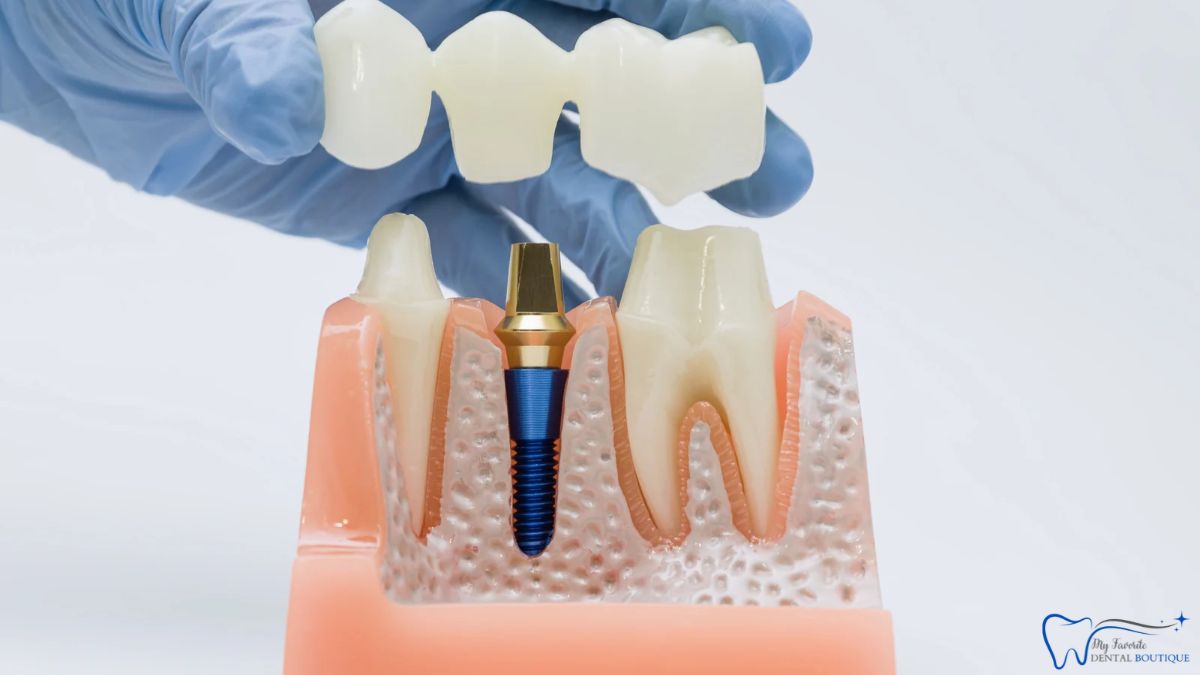
If you’re missing a tooth, you have two great permanent options: a dental implant or a dental bridge. Both fill the gap, both look natural, and both let you chew and smile with confidence again. But they work very differently, and the right choice depends on your mouth, your budget and your long-term goals.
At My Favorite Dental Boutique in Longwood, FL, this is one of the most common questions we hear. Here’s a straightforward look at how implants and bridges compare, so you can walk into your consultation already knowing what to ask.
What Is a Dental Implant?
A dental implant replaces the whole tooth, root and all. A small titanium post is placed in your jawbone where the natural root used to be. Over a few months, the bone bonds to the post (a process called osseointegration). Then a custom crown is attached on top.
The result is a standalone tooth. It doesn’t lean on your neighboring teeth for support, and because it sits in the bone, it passes chewing pressure into your jaw the way a natural root does. That pressure is what keeps the jawbone healthy.
Want the full step-by-step? Read our guide to single tooth dental implants.
What Is a Dental Bridge?
A traditional dental bridge “bridges” the gap using the teeth on either side of it. Those two teeth (called abutment teeth) are reshaped and capped with crowns, and a false tooth (called a pontic) is attached between them. The whole piece is cemented in place, so it doesn’t come out.
Bridges have been used successfully for decades. They’re faster to complete than an implant and don’t require surgery. The trade-off is that they rely on your neighboring teeth, and those teeth have to be filed down permanently to hold the crowns.
Implants vs. Bridges: Side by Side
| Dental implant | Dental bridge | |
|---|---|---|
| How long it lasts | The post can last decades, often a lifetime. The crown may need replacing after 10 to 15 years. | Usually 10 to 15 years |
| 10-year success rate | About 96% | About 89% |
| Effect on neighboring teeth | None. Nearby teeth are left alone. | The two teeth beside the gap are permanently filed down for crowns. |
| Jawbone health | Stimulates the bone and helps prevent bone loss | The bone under the false tooth slowly shrinks over time |
| Upfront cost | Higher | Lower |
| Long-term cost | Often lower, since it rarely needs replacing | Can add up if the bridge or support teeth need work later |
| Treatment time | Usually 3 to 6 months, including healing | Usually 2 to 3 weeks |
| Surgery | Yes, a minor procedure to place the post | No |
| Daily care | Brush and floss like a natural tooth | Needs a floss threader or special brush to clean under the bridge |
Success rates are from published research reviews (Journal of Dentistry, 2019, for implants; Clinical Oral Implants Research, 2004, for bridges).
Which One Is Right for You?
There’s no one-size-fits-all answer. Here’s how we usually think about it.
An implant may be the better fit if:
- The teeth next to the gap are healthy and you’d rather not file them down
- You want the longest-lasting option and are thinking 20 years ahead
- You want to protect your jawbone and the natural shape of your face
- You’re in good general health and have enough bone to support the post (if not, a bone graft can often help)
A bridge may be the better fit if:
- The teeth next to the gap already have large fillings or need crowns anyway, so the bridge fixes two problems at once
- You need the tooth replaced quickly
- You’d prefer to avoid surgery, or a health condition makes surgery a concern
- There isn’t enough bone for an implant and a graft isn’t a good option for you
The best way to know is a quick exam and X-rays. We’ll look at your bone, your neighboring teeth and your goals, then walk you through both options honestly.
Frequently Asked Questions
Is a dental implant better than a bridge?
For many people, yes, because an implant lasts longer, protects the jawbone and leaves neighboring teeth untouched. But a bridge can be the smarter choice when the nearby teeth already need crowns or when surgery isn’t a good option.
Does getting an implant hurt?
The procedure is done with local anesthesia, so most patients feel pressure rather than pain. Mild soreness for a few days afterward is normal and usually manageable with over-the-counter pain relievers.
Can I get an implant if I already have a bridge?
Often, yes. When an old bridge wears out, many patients switch to an implant. If bone has shrunk under the bridge, a bone graft may be needed first.
Does insurance cover implants or bridges?
Many dental plans cover part of a bridge, and more plans now cover part of an implant too. Coverage varies a lot, so our team can check your benefits before you decide.
What happens if I leave the gap alone?
Over time, the teeth around the gap can drift or tip into the space, the opposing tooth can shift, and the jawbone in that spot slowly shrinks. Replacing the tooth sooner usually means more options and a simpler treatment.
Talk to a Longwood Dentist About Your Options
You don’t have to figure this out alone. At My Favorite Dental Boutique, Dr. Paula Grisales and our team will look at your smile, explain what we see, and help you choose the option that fits your health, your timeline and your budget. We speak English and Spanish, and we’re happy to answer every question.
Call us at (407) 339-4700 or book online to schedule your consultation. We’re at 1670 S. US Highway 17-92 in Longwood, FL.
Learn more: Dental Implants in Longwood, FL
